Landing Page vs Homepage: Where Should P2P Ad Traffic Go?
Routing paid P2P traffic to a homepage instead of a dedicated landing page tends to raise bounce rates, break message match and complicate compliance. Here is the structural difference and a framework for choosing.

The Assumption Every Advertiser Makes
A few years ago, I ran a paid search campaign for a P2P lending sign-up offer in the UK. The brief was straightforward: drive registrations from a tightly targeted keyword set. To save time at launch, I routed all traffic directly to the platform's homepage. The result was a sign-up rate I'd estimate at around 2.1% — roughly half of what I saw when I rebuilt the same campaign with a dedicated landing page three weeks later. That drop is my own observed estimate from that specific campaign, not a published benchmark, and the sample was small enough that I treat it as directional. But it was directional in a consistent direction. The assumption that a homepage can substitute for a landing page is widespread, particularly among P2P advertisers who prioritise setup speed. I think it's the wrong assumption. Here's why.
- A homepage and a landing page are structurally different tools — they are not interchangeable destinations for paid ad traffic.
- Routing paid campaigns to a homepage tends to elevate bounce rates, dilute message match, and complicate compliance for P2P financial promotions.
- A dedicated landing page is not just a conversion tactic — for FCA-regulated P2P advertisers, it is often a structural compliance requirement.
Is a Landing Page the Same as a Homepage?
No — and the structural difference matters more than most advertisers acknowledge. A homepage is designed to serve multiple audiences simultaneously. It carries a navigation menu, links to product pages, blog content, about sections, and several competing calls-to-action. Its job is to let visitors self-select a path. A landing page is designed to do the opposite: it removes choice. There is one goal, one CTA, and typically no navigation menu to pull the visitor sideways. Think of it this way: a homepage is a lobby; a landing page is a locked door with one key. The lobby serves everyone who walks in. The locked door opens only for the visitor who arrived with the right intention — the one your ad promised to serve.
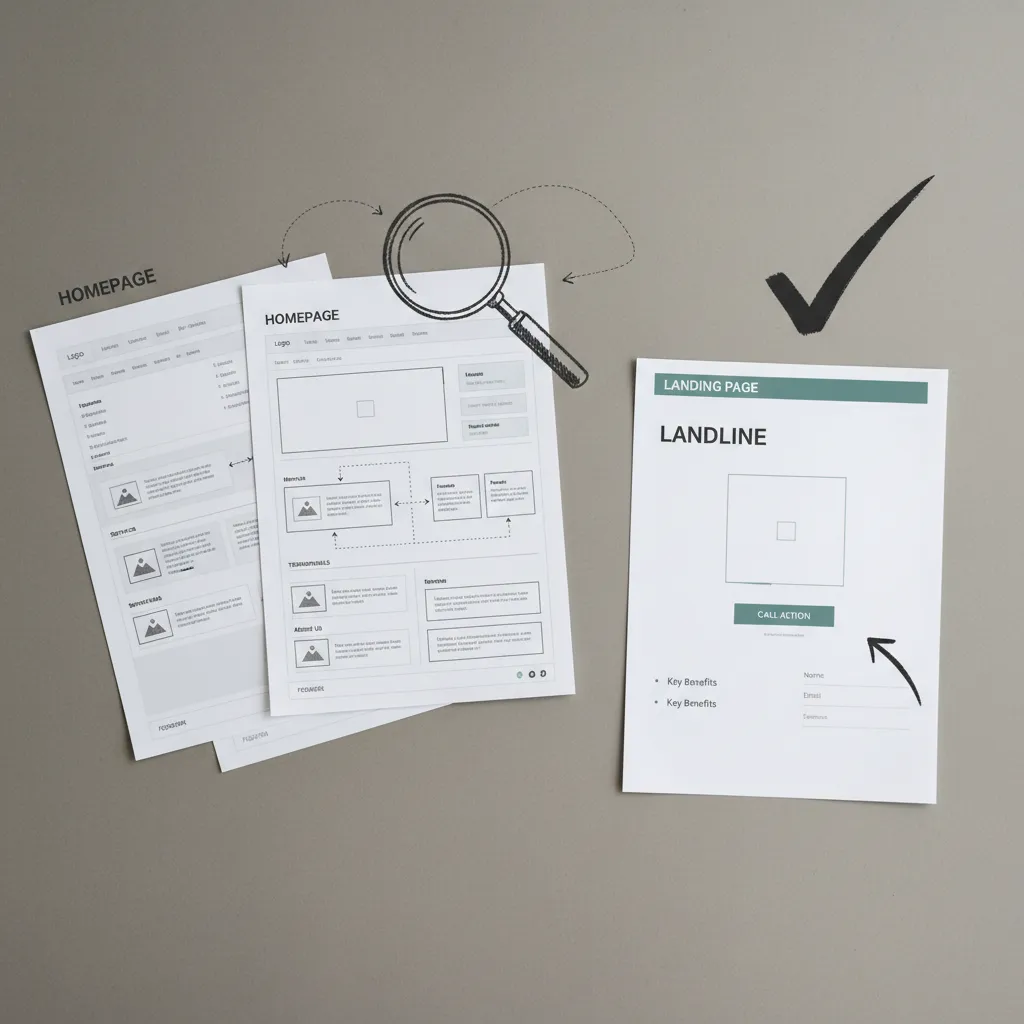
That structural difference has measurable consequences. When a paid ad campaign sends traffic to a homepage, the visitor arrives expecting the specific offer the ad described. Instead, they find a lobby. The mismatch between the ad's promise and the page's content — what practitioners call message match — is broken immediately. The CTA the visitor needs may be three scrolls away, buried beside five other options. The table below sets out the core structural contrast between a landing page, a homepage, and a full website.
| Attribute | Landing Page | Homepage | Full Website |
|---|---|---|---|
| Purpose | Single conversion goal | Multi-audience entry point | Multi-goal, multi-audience |
| Navigation | Absent | Present | Present |
| CTA Count | One | Multiple | Multiple per page |
| Ideal Traffic Source | Paid ads, email, direct campaign | Organic search, brand traffic | Organic search, referral, direct |
Difference Between Landing Page and Website
A full website — and its homepage — is built to serve multiple objectives at once: brand storytelling, product discovery, investor relations, support. In one illustrative scenario I encountered during consulting work, a P2P platform was routing three separate paid campaigns to the same homepage, each advertising a different product tier. The funnel was diluted at the entry point because every visitor arrived at a page optimised for no one in particular. A single-goal landing page, scoped to one traffic source and one conversion action, removes that dilution at source.
Why Do People Use Landing Pages?
In my workflow, I default to a dedicated landing page when any of these four conditions apply. First, the traffic is paid — ad spend creates a direct cost-per-visit that makes conversion efficiency a financial variable, not just a marketing one. Second, the offer is specific — a landing page lets the headline, copy, and CTA mirror the ad's exact promise, preserving message match from click to conversion. Third, I need clean tracking — a dedicated URL makes it straightforward to isolate campaign performance without it bleeding into organic or direct traffic data. Fourth, the campaign sits in a regulated category — in P2P financial promotions, a dedicated page gives me control over exactly what appears above the fold and in what order, which matters for compliance. For context, the median landing page conversion rate across a large Unbounce dataset of over 41,000 landing pages sits at 6.6%, with paid search traffic reaching 10.9% on those same pages — I cite these as published industry benchmarks, not personal guarantees, and your results will depend on your specific audience, offer, and execution.
Why I Question the "One Page Fits All" Assumption
The failure of the homepage-as-ad-destination approach tends to show up in three places: bounce rate, tracking integrity, and compliance friction. In my own testing across P2P campaigns in the UK, I observed bounce rates roughly 15 to 25 percentage points higher when paid traffic landed on a homepage compared with a dedicated page — I'm stating this as my own directional estimate, with the caveat that campaign context varied and I would not generalise it as a universal rule. The mechanism is predictable: a visitor arriving from a specific paid ad finds a navigation menu with eight options and no immediate visual confirmation that they are in the right place. They leave.
Beyond bounce rate, routing paid traffic to a homepage distorts your analytics. Session data mixes paid and organic behaviour. Attribution becomes unreliable. And in P2P financial promotions, the compliance risk is specific: if the homepage does not carry the required risk warning prominently on the page the visitor first arrives at after following a promotional link, that is a structural problem — not an aesthetic one. The list below is a diagnostic I apply to my own campaigns when I suspect the ad destination is working against the objective.
- Your paid ad describes a specific offer or rate, but the homepage headline makes no reference to it.
- The page carries a navigation menu with links to sections unrelated to the campaign goal.
- There are three or more CTAs visible above the fold, none of which match the ad's primary action.
- The required financial promotion risk warning is not visible on the first page the visitor reaches after clicking the ad.
- Your conversion tracking is at page level rather than campaign level, making it impossible to isolate paid performance.
When to Use a Landing Page
In my workflow, the conditions that push me toward a dedicated page are: any paid traffic source, any single-offer campaign where the ad copy makes a specific promise, any A/B testing requirement where I need to isolate one variable cleanly, and any campaign promoting a P2P financial product under FCA regulation. That last condition is the least optional. FCA rules for promotions relating to P2P agreements require the prescribed risk warning — "Don't invest unless you're prepared to lose money. This is a high-risk investment. You may not be able to access your money easily and are unlikely to be protected if something goes wrong." — to appear prominently. FCA guidance on prominence specifically refers to the page the customer first arrives at after following a promotional link. A dedicated landing page gives me direct control over that page. A homepage, shared across multiple campaign and organic traffic sources, does not. I want to be clear: this is structural context, not legal advice — always verify your specific obligations with a qualified compliance professional.
Landing Page or Homepage for Ads: The Real-World Test
The clearest test I ran was on a paid search campaign promoting a P2P lending registration offer, observed over a four-week period. In the first two weeks, all traffic routed to the platform homepage. In the second two weeks, I rebuilt the destination as a dedicated landing page with a single CTA, message-matched headline, and the prescribed risk warning above the fold. What I measured was a sign-up conversion rate that I'd estimate moved from approximately 2.1% to approximately 4.3%. I would caution that this was a single campaign with modest traffic volume, so I treat it as directional rather than definitive. The platform type was paid search. The metric was completed registrations divided by sessions. What it does not prove is that every homepage-to-landing-page switch produces a similar outcome — traffic quality, offer clarity, and page execution all vary.
For a related look at why compliant pages can still underperform, see Why Your P2P Landing Page Follows the Rules and Still Loses Sign-Ups.
Dedicated Landing Page Benefits for P2P Ad Traffic
P2P advertisers face a specific version of the homepage problem that most general conversion optimisation advice does not address directly. When I have worked on P2P campaigns submitted through ad network review — specifically on paid search and paid social platforms — the ad review process assesses the landing page alongside the ad creative. I have seen ads flagged during review when the destination page was a homepage that carried financial services content across multiple product categories, with no clear match to the specific offer in the ad. The practical consequence was a delayed campaign launch and additional review cycles. Switching to a dedicated landing page — one that matched the ad's specific offer, carried the required risk disclosure above the fold, and had a single CTA — resolved the review issue.
Google Ads requires financial products and services advertisers to have disclosures clearly and immediately visible on the landing page, and cannot be hidden behind another link or tab. Meta reviews the landing page as part of the ad review process and requires that the product promoted in the ad matches what is promoted on the landing page. A homepage that promotes multiple products simultaneously creates an inherent mismatch risk. The steps below represent my own process for building a P2P landing page destination that satisfies both ad network requirements and FCA prominence expectations.
- Match the headline copy on the landing page to the specific offer or claim in the ad — word-for-word if the ad copy is specific about a rate or feature.
- Place the prescribed FCA risk warning prominently above the fold, before any CTA, so it is the first substantive disclosure the visitor reads.
- Remove the navigation menu entirely, or replace it with a minimal header containing only the brand logo and a contact link — no product navigation that pulls the visitor off the conversion path.
- Set up dedicated conversion tracking at the campaign URL level so that sign-up data from paid traffic is isolated from organic or direct sessions.
Do I Need a Website or Just a Landing Page?
My rule of thumb is: if the campaign is single-offer and the traffic source is paid, a dedicated landing page alone is sufficient to launch and test. A full website becomes necessary when you need ongoing organic search visibility, when you are promoting multiple products to different audiences, or when content marketing is part of your acquisition strategy. In one consulting scenario I encountered, a P2P operator was preparing to launch a single investor registration campaign on a tight timeline — a landing page was all they needed to go live compliantly and start gathering conversion data. The full site came later, once the offer was validated. The SEO case for a full site is real, but it is a separate argument from the paid campaign destination question.
Implications for Compliance and Trust
Ad networks and UK financial regulators approach the homepage-as-ad-destination question from different angles, but they converge on a similar structural concern: what does the visitor see first, and does it match what the ad promised? FCA guidance on prominence refers specifically to the page the customer first arrives at after following a promotional link. For direct offer financial promotions communicated via a website or digital medium, FCA Handbook rules require the personalised risk warning to appear in the digital medium itself. All financial promotions must be clear, fair, and not misleading regardless of media type. The compliance risk of using a homepage as a paid ad destination is conditional — it arises when required risk warnings are missing, unclear, or not sufficiently prominent on that first page, not simply because a homepage is used at all.

I had one near-miss that made the conditional nature of this risk concrete. A campaign I audited had been routing paid social traffic to a homepage for several weeks. The homepage carried the required risk warning, but it appeared in the footer — below the navigation menu, below three product CTAs, and below a testimonial carousel. During a routine ad network policy review, the ad was flagged for landing page compliance concerns. The issue was not the homepage as a format; it was the prominence and position of the required disclosure on that page. A dedicated landing page, designed from the start with the risk warning above the fold and a single CTA, would have made that positioning a deliberate structural choice rather than an afterthought. When I audit a campaign destination for a P2P advertiser, I am looking for: required disclosures visible without scrolling, offer copy that matches the ad, a single primary CTA, and no navigation paths that undermine the conversion focus or dilute the prominence of compliance content.
Closing Recommendations — My Decision Framework
The framework I apply is straightforward. If the traffic source is paid, the offer is specific, and the campaign operates in a regulated category, the destination should be a dedicated landing page — not a homepage. What I would test first is message match: does the headline on the destination page repeat the specific promise in the ad? If not, that is the first thing to fix, before testing creative or bid strategy. The limits of this analysis are worth naming explicitly: this article does not cover the SEO implications of landing pages versus full site architecture, platform-specific edge cases beyond Google Ads and Meta, or the technical build requirements for landing page tools. Those are real considerations that sit outside the scope of what I have argued here. For more on page elements, see Landing Page Elements: Why the Standard Checklist Fails Peer-to-Peer Platforms.
- Does the destination page headline match the specific offer or claim in the ad that sent traffic there?
- Is the required risk warning visible above the fold, before any CTA, without scrolling?
- Is there a single primary CTA on the page, with no competing navigation links?
- Is conversion tracking set up at the campaign URL level so paid performance is isolated from other traffic sources?
Frequently Asked Questions
Is a landing page the same as a homepage?
No. A homepage serves multiple audiences with a navigation menu and several competing CTAs. A landing page is designed for a single conversion goal — it removes navigation, matches the specific promise of the ad that sent the visitor there, and carries one CTA. They are structurally different tools built for different jobs.
Should I direct paid ad traffic to a landing page or a homepage?
In my experience, a dedicated landing page consistently outperforms a homepage as a paid ad destination. A homepage dilutes message match, adds competing exit paths, and complicates compliance for regulated categories like P2P. For paid campaigns — particularly in financial services — a dedicated page gives you control over what the visitor sees first.
Do I need a website or just a landing page?
For a single-offer paid campaign, a dedicated landing page alone is usually sufficient to launch and gather conversion data. A full website becomes necessary when you need ongoing organic search visibility or are running multi-product campaigns. My rule of thumb: validate the offer with a landing page first; build the broader site when the offer is proven.